

By Cara Cowan Watts, Cherokee411.com
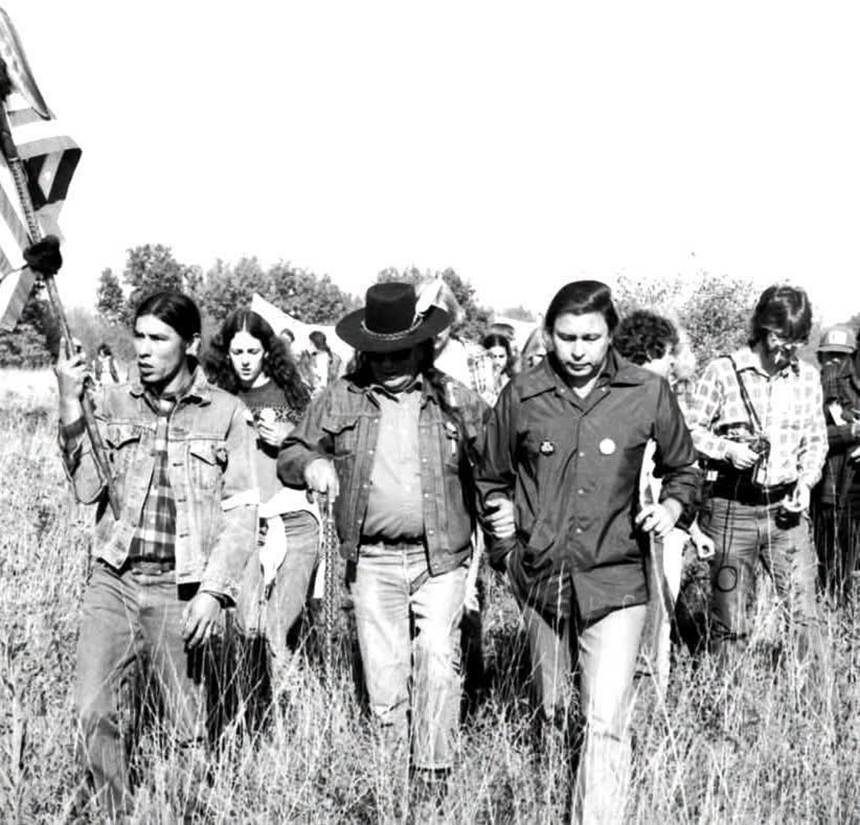
Cherokee Nation citizen Wes Studi, left, carries a U.S. flag as he leads anti-nuclear protesters toward the Black Fox nuclear plant construction site near Inola, Okla., on Oct. 7, 1978. Beside him are Mohawk spiritual leader Frank Thomas, center, and Seneca-Cayuga Nation citizen Jay WhiteCrow, right. (John Southern/Tulsa World)
INOLA, Okla. A black-and-white photograph of Cherokee Nation citizen Wes Studi leading protesters toward the Black Fox nuclear plant construction site is circulating again on social media. Nearly 50 years after it was taken, Inola residents are fighting a proposed $4 billion aluminum smelter on the same land.
Tulsa World photographer John Southern took the photo on Oct. 7, 1978. Studi carries a U.S. flag at the front of the march. Beside him are Frank Thomas, a Mohawk spiritual leader according to Tulsa World archival captions, and Jay WhiteCrow, a Seneca-Cayuga Nation citizen. The newspaper reported that nearly 400 people marched more than a mile to the edge of the construction site, where they were arrested for trespassing.
WhiteCrow co-founded the American Indian Theater Company of Oklahoma, the troupe Studi later joined to begin his acting career, and directed the Tulsa Indian Council on Alcoholism and Drug Abuse. He died in 2008 at 73. Thomas and WhiteCrow also recorded “Song of the Great Spirit” for “Black Fox Blues: Music From the Movement,” a 1978 benefit album opposing the plant.
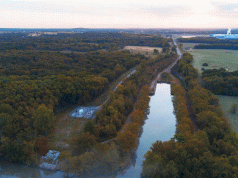
The link between the two fights is more than symbolic. In 2019, Public Service Company of Oklahoma transferred the more than 2,000 acres it had acquired for Black Fox to the City of Tulsa-Rogers County Port Authority. That land became the Tulsa Port of Inola, where Emirates Global Aluminium and Century Aluminum now plan to build the smelter.
PSO announced the nuclear project in May 1973. The utility named the site Black Fox, and the Town of Inola says the town’s name comes from the Cherokee word for black fox.
Carrie Barefoot Dickerson, a Claremore teacher and nurse, organized the opposition. In 1973 she founded Citizens’ Action for Safe Energy, which she co-chaired with Ilene Younghein of Oklahoma City. The fight lasted nine years. To pay legal bills, she and her husband mortgaged their family farm and sold Aunt Carrie’s Nursing Home in Claremore.
Opposition grew after the 1979 partial meltdown at Three Mile Island, and hundreds of protesters were arrested at the Black Fox site that June. On Feb. 16, 1982, PSO announced it would not build the plant. The Carrie Dickerson Foundation says Black Fox was the only U.S. nuclear plant canceled through a combination of legal and citizen action after construction had started.
The Dickerson family was Cherokee. Carrie’s husband, Charles Robert “Robert” Dickerson, was a Cherokee Nation citizen, a dairy farmer, and a fellow Oklahoma State University graduate. In a Voices of Oklahoma oral history, their daughter Patricia Lemon said her paternal grandmother, Anna Victoria Haynes, was a Cherokee from Sageeyah, near the Verdigris River outside Claremore.
Robert Dickerson died in early 1981, about a year before Black Fox was canceled. Carrie Dickerson died Nov. 17, 2006, in Claremore at age 89. With Lemon, she wrote “Black Fox: Aunt Carrie’s War Against the Black Fox Nuclear Power Plant,” published in 1995.
Her two surviving daughters were both Cherokee Nation citizens, and both have since died. Florence Dickerson Snelling was born Jan. 3, 1942, in Claremore and died June 4, 2011, at age 69.
Patricia Dickerson Lemon was born Jan. 19, 1940, in Claremore and died Sept. 7, 2023, in Leesburg, Virginia, at age 83. She won a National Merit Scholarship to Radcliffe College and served nearly a decade on the Selectboard in Warwick, Massachusetts. She was also a lifelong member of the Indian Women’s Pocahontas Club.
Both sisters are buried in Sageeyah, as is their younger sister, Mary Dickerson, who died in 2005.
Author’s note: I knew both of Carrie Dickerson’s daughters, who inherited their mother’s drive to help their community. While I served on the Cherokee Nation Tribal Council and Cherokee Nation citizen Brad Carson served in the U.S. House, Patricia Lemon helped me secure funding for the Cherokee Nation’s Three Rivers Health Center in Muskogee.
The smelter is a joint venture owned 60% by EGA and 40% by Century. Federal officials say it would be the first new U.S. primary aluminum smelter since 1980. The complex would cover about 350 acres along the Verdigris River, within about 3 miles of Inola’s schools, homes, and farms, according to Oklahoma Attorney General Gentner Drummond.
Drummond sued to block the project on June 2 in Rogers County District Court. The case was moved to federal court, and on July 23 the state asked to send it back. Inola’s council has extended its moratorium on primary aluminum smelting through April 7, 2027. On that day, residents will vote on whether to ban smelting in the town permanently.
The companies are pressing ahead. During Century’s third-quarter earnings call, CEO Jesse Gary said the project was “moving forward on all fronts.” Gov. Kevin Stitt has said the industrial park could be moved outside the town limits if the council keeps opposing it.
The site is within the Muscogee (Creek) Nation’s boundaries, about 3 miles from the jurisdictional boundaries of the Cherokee Nation and the UKB. The Verdigris River runs through the site and joins the Arkansas River at Three Forks near Muskogee.
The Oklahoma Sustainability Network still presents the Carrie Dickerson Lifetime Achievement Award in her name.
Wado.
Cara Cowan Watts is a journalist for Cherokee411.com, an independent media company serving all three Cherokee Tribal Nations and Cherokees wherever they live. Contact: Cherokee411.com.
Cherokee 411 | 1827 W Reno St., Broken Arrow, OK 74012 | Phone: (918) 401-0370 | Email: [email protected]
Sources
- Carrie Dickerson Foundation, Life and Legacy: https://www.carriedickersonfoundation.org/lifelegacy.html
- Voices of Oklahoma, Carrie Dickerson oral history: https://voicesofoklahoma.com/interview/dickerson-carrie
- Rice Funeral Service, Florence Dickerson-Snelling obituary: https://www.ricefuneralservice.com/obituaries/Florence-NMN-Dickerson-Snelling?obId=28536897
- Adams Green Funeral Home, Patricia Anne Dickerson Lemon obituary: https://adamsgreen.funeraltechweb.com/tribute/details/13561/Patricia-Lemon/obituary.html
- Mary Dickerson obituary, 2005 (GenLookups archive): https://genlookups.com/ok/webbbs_config.pl/read/268
- Tulsa World, Throwback Tulsa in the 1970s (photo credit): https://tulsaworld.com/news/local/history/throwback-tulsa-to-the-1970s-photos-from-the-tulsa-world-archive/collection_e3760364-d03f-11eb-a4f4-43e718bcc363.html
- Tulsa World, Wes Studi retrospective: https://tulsaworld.com/news/local/history/happy-birthday-to-actor-wes-studi-a-look-back-at-his-life-and-legacy/collection_a1e88a36-029f-52bb-988d-af36d520142f.html
- Jay Corbett WhiteCrow Sr. obituary, Joplin Globe: https://www.legacy.com/obituaries/joplinglobe/obituary.aspx?pid=119626904
- “Black Fox Blues: Music From the Movement,” Discogs: https://www.discogs.com/release/7847514-Various-Black-Fox-Blues-Music-From-The-Movement
- Tulsa Flyer, Wes Studi honored at TCC: https://tulsaflyer.org/2025/11/13/culture/post/tcc-students-honor-wes-studi/
- Town of Inola, Black Fox protest history: https://www.inolaok.com/black-fox-protest
- Public Radio Tulsa, 2019 land transfer: https://www.publicradiotulsa.org/local-regional/2019-10-10/pso-gives-city-of-tulsa-rogers-county-port-authority-site-once-proposed-for-nuclear-plant
- Oklahoma Historical Society, Nuclear Power: https://www.okhistory.org/publications/enc/entry?entry=NU001
- Oklahoma Attorney General, June 2, 2026 release: https://content.govdelivery.com/accounts/OKAG/bulletins/41a0f5d
- U.S. Department of Energy: https://www.energy.gov/node/4856035
- Alcircle, Inola moratorium extension: https://www.alcircle.com/news/inola-aluminium-smelter-timeline-stretches-to-april-2027-after-new-moratorium-us-capacity-push-continues-121181
- Manufacturing Dive, Century Aluminum Q3 call: https://www.manufacturingdive.com/news/century-aluminum-ceo-oklahoma-project-on-track-community-concerns-q3-2026/873971/
- Reuters via Kitco, next steps for the Inola smelter: https://www.kitco.com/news/off-the-wire/2026-09-18/whats-next-trumps-aluminum-smelter-project-oklahoma