
A 1967 Canadian documentary about fluoride, dying cattle, and a plant once hailed as progress reads like a preview for Rogers County, the Verdigris River, and the Tribal Nations downwind.
By Cara Cowan Watts, Cherokee411.com
On Sunday night, Oct. 22, 1967, the Canadian Broadcasting Corporation aired a special called “The Air of Death.” Hosted by national news anchor Stanley Burke, it took viewers to Dunnville, a quiet agricultural area in southern Ontario.
The Dunnville story started the way the Inola story started: with good news. A new phosphate fertilizer plant opened there in 1960 and brought new paychecks and new life to the local economy, Burke told viewers. Then the plume from the plant’s stack began carrying fluorine for miles across the countryside.
The documentary showed what followed. Cattle developed fluorosis, with swollen joints, falling teeth, and pain severe enough that animals lay down and died. Peppers and fruit burned. One farmer said his grain yields were cut roughly in half. A 20-year-old orchard had not produced fruit for market in six years. Eight local cattlemen were out of the cattle business entirely. Under arbitration, the plant’s owner, Electric Reduction Company, paid farmers $218,000 for lost crops and cattle.
The plant employed 300 people, and the local reeve told The Canadian Press its tax bill made up 75% of his township’s tax revenue. The plant manager said the company had seen no evidence that human health had been affected. Ontario Health Minister Matthew Dymond told the CBC the company had controlled about 90% of its emissions, but that the remaining 10% was still too much. Then he said something every regulator in Oklahoma should tape to the wall: “life is far more important than anything that comes out of any plant.”
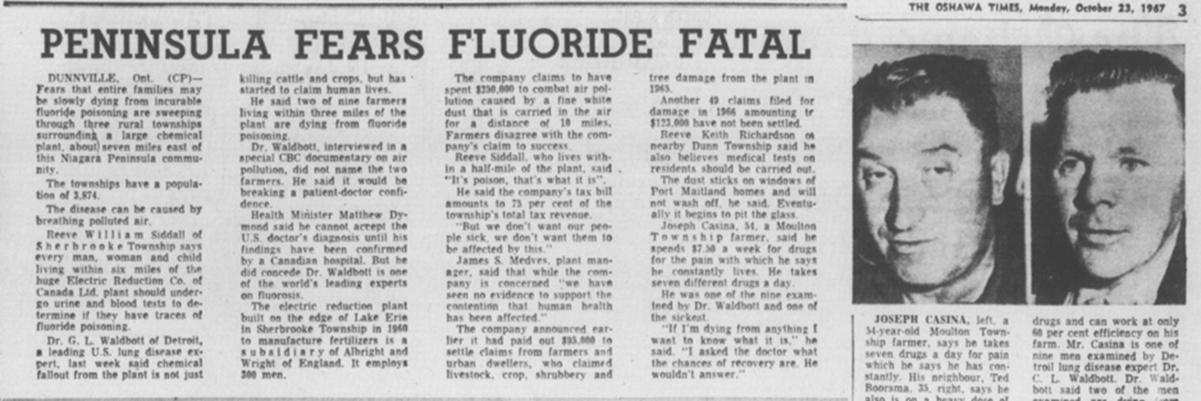
The Oshawa Times reported on Oct. 23, 1967, the day after “The Air of Death” aired, that families living around the Electric Reduction Co. fertilizer plant near Dunnville, Ont., feared they were being poisoned by fluoride.
Image: The Oshawa Times, Oct. 23, 1967, p. 3, via Oshawa Public Libraries and Ontario Community Newspapers.
The broadcast’s claim that people, not only livestock, were being poisoned set off a firestorm. Industry and provincial officials pushed back hard, and the film and its makers were investigated by an Ontario Royal Commission and by Canada’s broadcast regulator, the Canadian Radio-Television Commission. The human-health allegations stayed in dispute. But the regulator concluded the program had accomplished its purpose of awakening the public to the very real dangers of air pollution. In September 1969, University of Toronto students and professors founded Pollution Probe in the documentary’s wake, and it became one of Canada’s most influential environmental organizations.
The original broadcast is not on mainstream streaming services, but the CBC’s full narration and interviews are preserved in a published transcript. It is worth every Rogers County resident’s time.
Fluoride is part of the recipe
Fluoride is not a side issue for an aluminum smelter. Primary aluminum is made by running electric current through alumina dissolved in a molten fluoride bath, and fluoride escapes from the potlines as hydrogen fluoride gas and fine particulates. The developers say as much: they describe fluoride as an expensive raw material essential to production.
The proposed Oklahoma Primary Aluminum smelter is a $4 billion joint venture of Emirates Global Aluminium, which holds 60%, and Chicago-based Century Aluminum, which holds 40%. Planned for the Tulsa Port of Inola, it would be the first new primary aluminum smelter built in the United States in nearly 50 years and is expected to produce 750,000 tons of aluminum a year, more than doubling current U.S. production. Attorney General Gentner Drummond’s lawsuit says the complex would cover about 350 acres along the Verdigris River, within about three miles of Inola’s schools, homes, and farms.
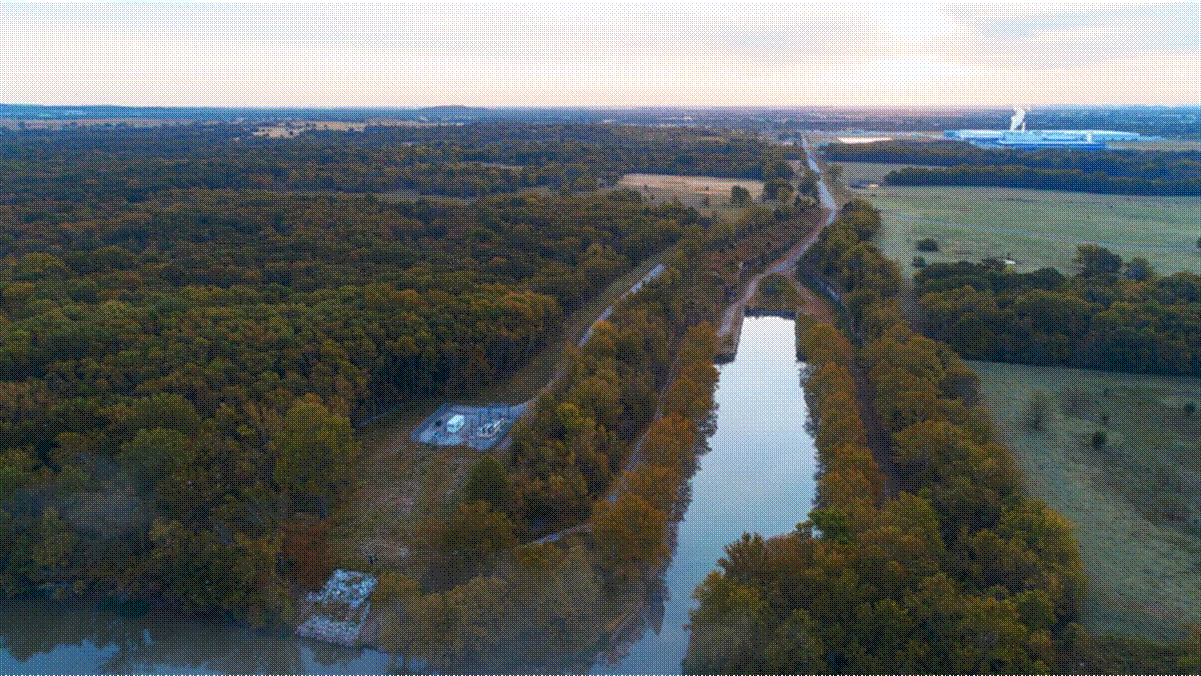
The Tulsa Port of Inola, seen from the air along the Verdigris River in Rogers County, is the proposed site of the $4 billion Oklahoma Primary Aluminum smelter.
Photo courtesy of Tulsa Ports.
The developers deserve credit where it is due. Their original air permit application used a maximum fluoride rate of 1.02 pounds per ton of aluminum, the federal level. After the Oklahoma Department of Environmental Quality and surrounding communities raised concerns, they cut that limit 37%, to 0.64 pounds per U.S. ton, which Century says would be the lowest limit for any U.S. primary aluminum plant. They say the plant will be engineered to capture and reuse about 99% of potroom fluoride, and they project more than 4,000 construction jobs and 1,000 permanent jobs. A company spokesman has said the smelter can operate safely alongside Inola’s farms and ranches.
Those are real commitments, and community pressure produced them. They are also the beginning of the conversation, not the end of it.
By our calculations
Percentages and per-ton limits tell you how clean each ton of aluminum is. Dunnville’s plant had controlled about 90% of its emissions, too. Pastures, cattle, and people live with the total.
By Cherokee 411’s calculations, if the Inola smelter produced 750,000 metric tons a year, about 827,000 U.S. tons, and its potlines emitted at the new 0.64-pound limit, that is roughly 529,000 pounds of fluoride a year. That is about 265 tons a year, or about 1,450 pounds every day. At the original 1.02-pound limit, it would have been about 422 tons a year, or 2,310 pounds a day. A permit limit is a ceiling, and actual emissions could run lower. But the ceiling is what the state would be approving.
Compare that with the Mohawk community of Akwesasne on the St. Lawrence River. Before 1973, the Reynolds Metals aluminum plant upwind of Cornwall Island emitted more than 300 pounds of fluoride an hour, or more than 7,200 pounds a day. After the company installed pollution controls in 1973, emissions fell to about 0.816 metric tons a day, roughly 1,800 pounds. Cornell University researchers still documented chronic fluoride poisoning in the island’s cattle. They also concluded the established fluoride tolerance level for cattle was not valid, because it was based on experiments with calves first exposed at 3 to 4 months old, not cattle exposed from conception to death. That second description is how a ranch herd actually lives.
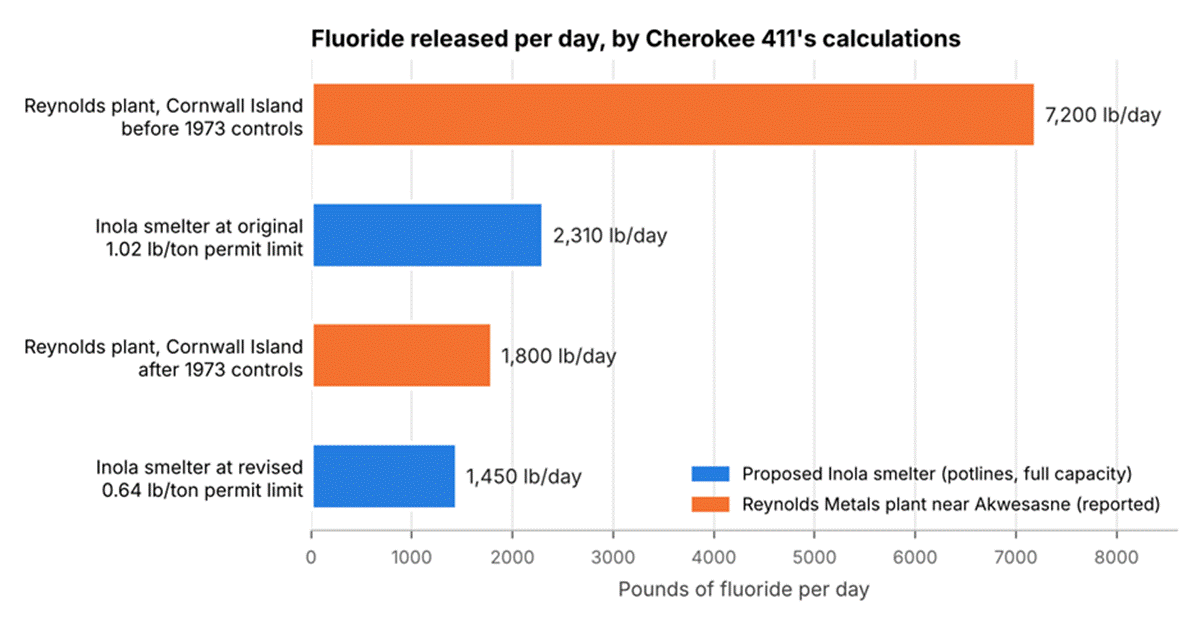
Daily fluoride from the proposed Inola smelter’s potlines at full capacity, 750,000 metric tons a year, under the original and revised permit limits, compared with fluoride emissions reported for the Reynolds Metals plant near Akwesasne before and after 1973 pollution controls. The plants are decades apart in technology and the figures are measured differently.
Chart: Cherokee 411. Data: Oklahoma Department of Commerce, News 9, Cornell Veterinarian, The Press (Christchurch, N.Z.).
These are not identical comparisons. But the question for regulators is not only whether each ton of Inola aluminum is cleaner than the last generation’s. It is how much fluoride lands on the hay meadows and pastures around Inola, year after year. As one Inola rancher pointed out to KJRH, fluoride does not break down once it is released into the environment.
Downwind is Cherokee Nation
The Akwesasne story should matter to every Tribal citizen in northeast Oklahoma. In the 1960s, Mohawk ranchers began reporting cattle with loose teeth and brittle bones. Mohawk chiefs on the Canadian side eventually filed a $150 million lawsuit against Alcoa and Reynolds Metals over fluoride and settled for $650,000 after legal fees nearly bankrupted the Tribe. The Saint Regis Mohawk Tribe says today that fluoride emissions from those plants caused cattle deaths in the 1960s and helped collapse the cattle industry near the plants.
Cherokee 411 has confirmed the Inola site lies within the Muscogee (Creek) Nation’s jurisdiction, approximately three miles from the Cherokee Nation and United Keetoowah Band border. It is also less than 10 miles from Hard Rock Hotel & Casino Tulsa in Catoosa, the Cherokee Nation’s flagship casino and a significant source of income for Cherokee Nation Businesses.
The National Weather Service says prevailing surface winds in the Tulsa area are southerly most of the year. In plain terms, on most days the wind would blow from the smelter toward Cherokee Nation, toward Claremore, and toward the farms and ranches where Cherokee Nation and UKB citizens live. My own family’s roots run through Tiawah, between Claremore and Inola, where my great-great-grandfather Dempsey Fields Coker held his allotment.
Downstream is everyone’s water
The smelter would sit on the Verdigris River, and the river does not stop at the port. Downstream, the City of Broken Arrow draws its drinking water from the Verdigris at its Verdigris River Water Treatment Plant in Wagoner County, which can produce about 30 million gallons a day. Wagoner County Rural Water District No. 5, which serves rural Coweta, Porter, and Red Bird, also draws its water from the Verdigris.
The Verdigris joins the Arkansas River at Three Forks near Muskogee. Below that point, the state’s comprehensive water plan lists the Arkansas River as the primary water source for Fort Gibson and Braggs. From there the river flows into Webbers Falls Reservoir and on toward Robert S. Kerr Reservoir.
So far, the state’s review has been about air. DEQ says water discharge, stormwater, and waste permits may also be required, but its smelter webpage lists no applications for them. At an April public meeting, a DEQ deputy executive director told Inola residents that water and waste were not in front of the agency that day. An Inola rancher has already asked the question that matters: where does all the captured fluoride go, whether into scrubber waste, baghouse dust, spent electrodes, or wastewater sent to the port’s new treatment plant?
Tribal Nations are speaking
The Muscogee National Council voted 15-0 on July 25 to oppose any aluminum smelter on Muscogee (Creek) Nation lands, and sponsor Rep. Anna Marshall said the Nation stands with the people of Inola, “not behind them.”
Cherokee Nation Principal Chief Chuck Hoskin Jr. raised concerns in an Aug. 7 statement. On Nov. 9, the Cherokee Nation Tribal Council voted unanimously for Resolution 47-26, sponsored by Councilors Joe Deere, Johnny Kidwell, and Julia Coates, which supports the Muscogee (Creek) Nation’s opposition and urges state and federal agencies to consult affected Tribes on a government-to-government basis.
Those resolutions and Hoskin’s statement call for consultation, but they are not the same as a formal demand. As of Nov. 27, Cherokee 411 found no formal written consultation request or demand letter from any Tribe to the State of Oklahoma, the Rogers County commissioners, the City of Tulsa-Rogers County Port Authority, or any federal agency, and no Tribe has announced a lawsuit to stop the smelter. Hoskin said in August that he had directed the Cherokee Nation Secretary of Natural Resources to engage with the entities building or regulating the smelter. But no consultation, written or in meetings, has been disclosed beyond DEQ’s public meetings and the Inola town meetings.
Consultation is not guaranteed, either. In October, the 10th U.S. Circuit Court of Appeals upheld the Environmental Protection Agency’s decision to give Oklahoma authority over environmental programs, including Clean Air Act, Clean Water Act, and Safe Drinking Water Act programs, without a requirement to consult Tribes. The Pawnee Nation had challenged that decision. The practical result is that the permits for this smelter rest with the state Department of Environmental Quality, and whether Tribal Nations are heard depends on whether the state chooses to listen.
Where things stand
DEQ is still reviewing the air permit application, which was filed in February and amended in September. As of Nov. 23, the agency listed its dispersion modeling technical meeting, its best available control technology meeting, and its draft permit public meeting as “to be determined.” Inola trustees extended a moratorium on primary aluminum smelting through April 7, 2027, the same day town voters will decide whether to ban it permanently. Drummond sued in Rogers County District Court on June 2 to block the project and, on Nov. 9, asked a judge to require the companies to disclose their ownership. Century Aluminum CEO Jesse Gary told investors the project is moving forward on all fronts.
What Dunnville would ask for
Good jobs and clean air and water are not opposites. But Dunnville and Akwesasne teach that the burden of proof has to come before the permit, not after the cattle go down. Before DEQ issues any permit, Oklahomans and their Tribal governments should insist on seven things:
- Publish the modeling first. Release the air dispersion and fluoride deposition modeling, with maps that extend into Cherokee Nation and down the Verdigris River, before the public comment period opens, not during it.
- Measure a baseline now. Fund independent sampling of forage, soil, water, and livestock fluoride on farms in every direction, in partnership with Muscogee (Creek) Nation, Cherokee Nation, and UKB environmental programs. Without a documented “before,” no rancher can ever prove an “after.”
- Put the water on the table. Make the smelter’s water discharge, stormwater, and waste plans public, and test the Verdigris at the Broken Arrow and Wagoner County intakes before and after operations begin.
- Monitor continuously and publicly. Require ambient fluoride monitors at the fence line and downwind, with data posted for anyone to see.
- Cap the total. Set an enforceable annual limit on total fluoride tons, not only a limit per ton of aluminum.
- Bond the promise. Create a bonded compensation fund for farmers and ranchers, so families are not left waiting on arbitration, as in Dunnville, or litigating for decades, as at Akwesasne.
- Consult every Nation in the airshed and watershed. Hold government-to-government consultation with the Muscogee (Creek) Nation, Cherokee Nation, and United Keetoowah Band, whether or not a court says the state must.
In 1967, Burke described the Dunnville stack as a former symbol of the town’s progress. The Canadians who watched decided progress needed rules, and they built a movement to write them. Inola residents are writing their own chapter now, in packed town meetings and with red-and-white yard signs. Tribal governments are writing theirs in council resolutions.
Read the transcript. Then sign up for DEQ notifications at oklahoma.gov/deq/aluminum-smelter-inola.html and show up when those “to be determined” meetings get a date. The air over Inola and the water below it belong to all of us who live downwind and downstream.
Wado.
Cara Cowan Watts is a journalist for Cherokee411.com, an independent media company serving all three Cherokee Tribal Nations and Cherokees wherever they live. She is a Cherokee Nation citizen and lives in Claremore. Contact: Cherokee411.com.
Cherokee 411 | 1827 W Reno St., Broken Arrow, OK 74012 | Phone: (918) 401-0370 | Email: [email protected] | Cherokee411.com
Sources
- Transcript of CBC’s broadcast “Air of Death” (1967), Fluoride Action Network: https://fluoridealert.org/content/cbc-transcript/
- York University Libraries, Clara Thomas Archives: Air of Death / CRTC hearings: https://atom.library.yorku.ca/index.php/air-of-death-crtc-hearings
- The Oshawa Times, Oct. 23, 1967, p. 3, “Peninsula Fears Fluoride Fatal” (Ontario Community Newspapers): https://news.ourontario.ca/3940514/page/4
- O’Connor, “An Ecological Call to Arms: The Air of Death and the Origins of Environmental Activism in Ontario,” Ontario History (2013): https://www.erudit.org/en/journals/onhistory/2013-v105-n1-onhistory03918/1050745ar/
- CRTC library record on the Air of Death program, aired Oct. 22, 1967: https://crtc.gc.ca/eng/library/Detail/catalog5405
- Ottawa Journal, CRTC report on Air of Death: https://www.newspapers.com/newspage/41479081/
- Pollution Probe, About us: https://www.pollutionprobe.org/?p=17
- Industrial Distribution, U.S. getting its first new aluminum production plant in nearly 50 years: https://www.inddist.com/operations/news/22960598/us-getting-its-first-new-aluminum-production-plant-in-nearly-50-years
- Oklahoma Attorney General, Drummond files action to block Inola aluminum smelter (June 2, 2026): https://content.govdelivery.com/accounts/OKAG/bulletins/41a0f5d
- Oklahoma Attorney General, Drummond seeks ownership disclosures (Nov. 9, 2026): https://oklahoma.gov/oag/news/newsroom/2026/november/drummond-seeks-ownership-disclosures-from-companies-behind-inola-smelter.html
- Oklahoma Department of Commerce, Oklahoma Primary Aluminum submits environmental plan to ODEQ: https://www.okcommerce.gov/oklahoma-primary-aluminum-submits-environmental-plan-to-odeq/
- News 9, Inola smelter developers reduce fluoride emissions (Hot Seat): https://www.news9.com/hot-seat-okc/inola-oklahoma-aluminum-smelter-developers-reduce-fluoride-emissions
- FOX23/KRMG, Inola smelter developer answers questions about fluoride: https://www.krmg.com/2026/08/28/inola-aluminum-smelter-developer-answers-questions-about-fluoride-environment-safeguards/
- Century Aluminum, Oklahoma Primary Aluminum: https://centuryaluminum.com/?p=11157
- Tulsa Ports, Tulsa Port of Inola (photo): https://tulsaports.com/locate-here/tulsa-port-of-inola/
- KJRH, Environmental impact of smelter deserves much harder look, Inola farmer argues: https://www.kjrh.com/news/local-news/environmental-impact-of-smelter-deserves-much-harder-look-inola-farmer-argues
- KJRH, Doubts persist after DEQ meeting over proposed Inola aluminum smelter: https://www.kjrh.com/news/local-news/doubts-persist-after-deq-meeting-over-proposed-inola-aluminum-smelter
- Cornell Veterinarian via OSTI, Chronic fluoride poisoning in Cornwall Island cattle: https://www.osti.gov/biblio/6289800
- The Press (Christchurch, N.Z.), Nov. 28, 1980, “Latest research queries ‘safe’ fluoride levels” (Papers Past): https://paperspast.natlib.govt.nz/newspapers/CHP19801128.2.100
- Smoke Signals (Feb. 1, 1991), Akwesasne coverage, University of Oregon Libraries: https://oregonnews.uoregon.edu/lccn/sn93050714/1991-02-01/ed-1/seq-13/
- Saint Regis Mohawk Tribe, Vegetation and Fluoride: https://www.srmt-nsn.gov/environment/vegetation-and-fluoride
- National Weather Service Tulsa, Climatological Overview: https://www.weather.gov/tsa/climo_tulcliover
- City of Broken Arrow, Verdigris River Water Treatment Plant: https://brokenarrowok.gov/government/water-utilities/verdigris-river-water-treatment-plant
- U.S. Senate EPW testimony of Wagoner County Rural Water District No. 5 (2004): https://www.epw.senate.gov/public/index.cfm/hearings?Id=F8CEFFAF-802A-23AD-43B8-DC487B442DBB&Statement_id=12B1DC99-C9DB-47D1-AA72-AE72CA6A0EDC
- Wagoner County Rural Water District No. 5 listing: https://startpage.mapquest.com/us/oklahoma/rural-water-district-5-355923078
- Oklahoma Comprehensive Water Plan, Lower Arkansas Watershed Planning Region: https://digitalprairie.ok.gov/digital/collection/stgovpub/id/25107/
- Oklahoma Department of Wildlife Conservation, Webbers Falls: https://www.wildlifedepartment.com/fishing/wheretofish/northeast/webbers-falls
- KGOU, Cherokee Nation Principal Chief Hoskin calls for tribal input in development of Inola smelter: https://www.kgou.org/indigenous-news/2026-08-10/cherokee-nation-principal-chief-hoskin-calls-for-tribal-input-in-development-of-inola-smelter
- Tulsa Flyer, Muscogee Nation opposes Inola smelter: https://tulsaflyer.org/2026/07/28/news/post/muscogee-nation-opposes-inola-smelter-within-reservation/
- MVSKOKE Media, Muscogee (Creek) Nation joined by Cherokee Nation in opposition to proposed Inola smelter: https://www.mvskokemedia.com/muscogee-creek-nation-joined-by-cherokee-nation-in-opposition-to-proposed-inola-smelter/
- National Indigenous Times, Cherokee Nation Tribal Council committee opposes Inola smelter: https://nit.com.au/02-11-2026/27285/cherokee-nation-tribal-council-committee-opposes-inola-smelter
- Oklahoma DEQ, Proposed Aluminum Smelter Project: Inola: https://oklahoma.gov/deq/aluminum-smelter-inola.html
- Oklahoma Attorney General, Drummond asks DEQ to revise proposed rules (Oct. 8, 2026): https://oklahoma.gov/oag/news/newsroom/2026/october/drummond-asks-deq-to-revise-proposed-rules-continues-fight-against-inola-aluminum-smelter.html
- SMM News, Inola Town Council extends moratorium until 2027: https://news.metal.com/newscontent/104118682-inola-town-council-extends-moratorium-on-4b-aluminum-smelter-project-until-2027-amid-legal-and-environmental-concerns
- Manufacturing Dive, Century Aluminum CEO says Oklahoma project on track: https://www.manufacturingdive.com/news/century-aluminum-ceo-oklahoma-project-on-track-community-concerns-q3-2026/873971/