
By Cara Cowan Watts | Cherokee411.com
TAHLEQUAH, Okla. — May 29, 2026
The U.S. Department of the Interior has permanently withdrawn a solicitor’s opinion issued in the final days of the Biden administration that had given the United Keetoowah Band of Cherokee Indians a potential legal foothold for gaming operations and shared jurisdiction over the Cherokee Nation’s historic reservation. The withdrawal was signed May 22, 2026, by William L. Doffermyre, who has since resigned as Interior solicitor. Interior Secretary Doug Burgum appointed Principal Deputy Solicitor Damon Hagan as acting solicitor on May 26, following Doffermyre’s departure.
The revoked opinion, known as M-37084, had concluded that the Cherokee Nation’s reservation is also the United Keetoowah Band’s reservation for purposes of federal land-into-trust regulations; that UKB holds exclusive tribal jurisdiction over trust lands within the reservation; and that such lands qualify as Indian lands under the Indian Gaming Regulatory Act, making them eligible for gaming. In signing the withdrawal, Doffermyre determined that those legal conclusions do not represent the best interpretation of applicable laws, treaties, and federal and Supreme Court case law.
The Withdrawal
Doffermyre’s one-page memo, designated M-37089, states that all relevant Interior bureaus and offices must treat the permanent withdrawal as binding and authoritative until the Office of the Solicitor revisits the issue in a subsequent M-Opinion or other guidance. The opinion cites a series of treaties and court decisions in its footnotes, including the Treaty of New Echota (1835), the 1846 Treaty with the Cherokee Nation, and the Treaty with the Cherokee Nation of 1866, as well as multiple federal court rulings spanning from the 19th century through 2020.
The Biden-era opinion, M-37084, was issued Jan. 17, 2025 — three days before President Biden left office — by then-Solicitor Robert Anderson. Gregory Zerzan, Senior Advisor exercising the delegated authority of the Solicitor, placed it under suspension review along with all other M-Opinions issued during the Biden administration on Feb. 28, 2025.
Cherokee Nation Response
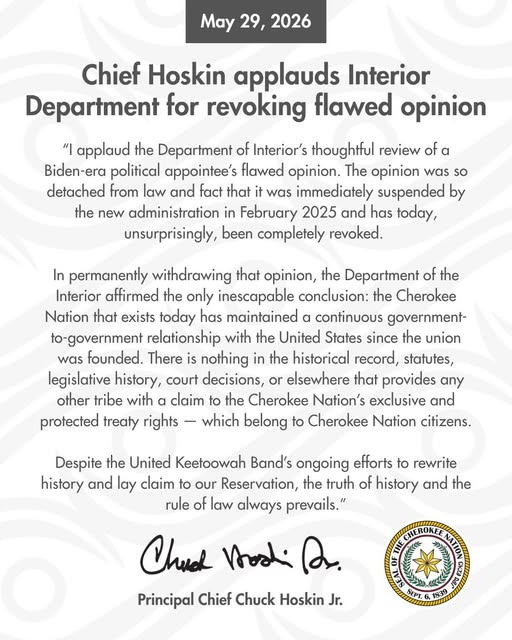
In a public statement dated May 29, 2026, Cherokee Nation Principal Chief Chuck Hoskin Jr. applauded the Interior Department’s action, characterizing M-37084 as a politically motivated opinion that was detached from law and fact.
“In permanently withdrawing that opinion, the Department of the Interior affirmed the only inescapable conclusion: the Cherokee Nation that exists today has maintained a continuous government-to-government relationship with the United States since the union was founded. There is nothing in the historical record, statutes, legislative history, court decisions, or elsewhere that provides any other tribe with a claim to the Cherokee Nation’s exclusive and protected treaty rights, which belong to Cherokee Nation citizens,” Hoskin said.
Hoskin also addressed the UKB directly, stating that “despite the United Keetoowah Band’s ongoing efforts to rewrite history and lay claim to our Reservation, the truth of history and the rule of law always prevails.”
United Keetoowah Band Response
The United Keetoowah Band of Cherokee Indians, a federally recognized tribe headquartered in Tahlequah, released its own statement calling the withdrawal “deeply flawed” and “completely disconnected from the historical and legal record.”
The UKB argued that M-37084’s 56-page analysis, supported by more than 400 citations, cannot be effectively countered by a withdrawal memo of a single sentence opposing its conclusions. The tribe noted that the withdrawal was the last public action taken by Doffermyre before his resignation. E&E News reported that Doffermyre left to consult for a Canadian mining company. Interior Secretary Burgum named Principal Deputy Solicitor Damon Hagan as acting solicitor on May 26.
“The historical and legal record underlying the United Keetoowah Band’s treaty-based rights was not created by an M-Opinion — nor is it erased by its withdrawal. No single administrative decision can rewrite history, nor extinguish the rights that flow from it,” the tribe said in its statement.
The UKB said its “ultimate vindication” will rely on judicial review, and that both the original M-Opinion and its withdrawal will necessarily be part of that legal record. The tribe indicated it will continue to pursue every available avenue under the law to uphold its treaty-based rights.
Gaming Implications
The practical consequences of the withdrawal are significant for the UKB’s long-standing effort to re-enter the tribal gaming market. The tribe operated a bingo hall in Tahlequah beginning in 1986, but was forced to close it in 2013 amid a Cherokee Nation lawsuit and pressure from state and federal regulators. The tribe lacks operating trust land sufficient for gaming under the current legal framework.
A partial reversal came in 2011 when the Interior Department agreed to take a 76-acre parcel into trust for the UKB. The Cherokee Nation sued to block the move, but the Tenth Circuit Court of Appeals ultimately upheld it in 2019. In May 2025, following the Biden-era M-Opinion, the UKB signed a gaming compact with the State of Oklahoma.
With M-37084 now permanently withdrawn, the legal basis for gaming on the reservation has been substantially weakened, though UKB officials say the fight is not over. Because gaming generally must occur on tribal land over which a tribe exercises governmental power, the withdrawal’s effect on the UKB’s compact and any proposed Tahlequah casino remains subject to ongoing litigation.
Background
The Cherokee Nation and the United Keetoowah Band are two of the three federally recognized Cherokee tribes in Oklahoma, along with the Eastern Band of Cherokee Indians in North Carolina. Both the Cherokee Nation and UKB are headquartered in Tahlequah and trace their origins to the historic Cherokee people. The two governments have been in a long-running dispute over territorial sovereignty, treaty rights, and gaming eligibility.
The Cherokee Nation operates 10 casinos across northeastern Oklahoma. The UKB has no casino operations at this time.
The full text of M-37089 is available at doi.gov or is included with this article.